Monday, May 28, 2012

Halifax, NS Beer Scene Roundup

I am in Halifax for work. Rather than process my notes, it is probably just as instructive to post them in their entirety:-

Halifax beer notes: Day One.

Place: Henry House (3oz samplers followed by a pint of the red)

Best Bitter
Decent, malty, casked with usual character. Bit thin. Not bitter.

Best Bitter Special
As above but dry-hopped with fuggles. Not overly detectable in this small sampler. A larger glass might have opened the aromas, but otherwise identical.

Peculiar
Modeled on Theakston's. Award-winning, but award not specified. Is indeed rather malty. Scotch whisky coloured, moderately thick head. As drinkable as OP but without the leathery notes of the original.

Keefe's Irish Stout
Very light for a stout. Closer to a dark mild in colour. Redder than a porter. Nitro-tapped. Decent body. Roasted bitterness is too light, but probably within range for an irish style? Have to check. Smells mainly of dust, to be honest.

Ringwood
Despite a little vegetal character, probably the best of the lot so far. Light colour: toward pale honey. It's a pale blond ale (whatever that means) hopped with Oregon fuggles. Gently hoppy. Dry and mildly apple-ish in the finish. What might constitute a collection of small flaws actually combines in a very drinkable beer.

Propeller IPA
Bitter. Light side of orange. No detectable head. Presumably also casked as it's flattish. Bittering hops dominate, very little aroma or flavour. Wouldn't order another.

Haddock and chips. Batter is underdone and mealy. Fish seems decent quality. Fairly well priced at $14 for two medium sized fish. The chips are the best bit. Darkish, double-fryed, and curly, with occasional scabs of skin. Coleslaw (poor) and tartare (decent) in prepared plastic containers — one of the worst customs of pub food. Smacks of no attention, regardless of ingredient quality.

McAuslan Oatmeal Stout
Bit of a write-off. Nitro tap, but to its detriment. Guinness works due to the slight sourness. This is just bland. Nitro should be used carefully. THis beer is calling out for some zing, and if the ingredients don't have it, the CO2 better had.

Garrison Irish Red Ale
*first one in a pint pot.
CO2, red as you could expect. Slight odor of straw and subtle hops. Very light body, which is good, as the hop profile couldn't carry much weight. Perfect carbonation. Mild blackberry smell coming off this one. Mildly uriney smell. That said, it's still drinkable.

Service: very good. Amiable, not over-indulgent, spotted two samplers in response to my queries.  

Place: Rogue's Roost

IPA
Decent. Citrusy, mid bitterness. Red colour. Thought it was the red ale initially. Slightly sryupy, without the bitterness to carry it off. Decent pint. Better than the Propeller.

Place: Hart and Thistle

Double Citra SMASH IPA
Murky mid orange colour. 2mm head, but lacing apparent immediately on pour. Looks like a 355 pour in a pub that's half mall, half mock-tudor "english" pub. Very good. Bitter as fuck. Probably not the 100IBUs but close to (chalkboard says "100+IBUs 7.5%") Mildest hint of feta cheese on the nose. More piney than I'd expect from a pure citra hop brew. A hint of chamomile nose comes through the rest. Very clean and dry. Despite some syrup on the mouthfeel, I'd put this as well attenuated, perhaps down to 1.010 or less. Lacing is gloopy, sticky, but sparse.

From the Hart and Thistle Brewer's blog*: (by the way, check out the "Messie" series on this blog. Accoriding to one of the H&T chefs, #3 is landing in August rather than in two weeks as the blog suggests)
Vital Stats:
Gravity - 17.3 P/1.071
IBU's - 100+ (324 Calculated)
Hop Rate - 8.2 lbs/bbl
ABV - 7.5 %
Colour ~ 7.0 SRM
Malt - Pale Ale
Hops - Citra

Notes on the above:

7.5 abv is not quite apparent, which I credit the hops for (rather than a lack of actual abv). It is very bitter. Colour is misreported from my sample. Looking at the SRM chart, I'd put this at 13, possibly 14.

Rock Bottom
They may well have a selection of local brews (brewed by Nash who also brews at Hart and Thistle), but they also have Peche Mortel in bottles. Either way, they did not have the Coffee IPA reported on the brewer's blog (the fact that it was tapped on Saturday and is absent come Monday illustrates Halifax's craft beer fanboys are good and keen at least). Peche it is then. Goodnight.


*"Nash" brews — from what I can ascertain from his wonderfully scattered blogposts — a massively impressive range of weird and edgy beers. Please do visit H&T and RockBottom if you get the chance. Plus, he swooped for the masterbrewer@gmail.com email address, so it's chutzpahx10.

Thursday, February 23, 2012

LDB Privatization: Gift Horse or Trojan Horse?

Many BC drinkers will have read the extraordinary news that parts of our province's antiquated Liquor Distribution Branch (LDB) are likely to be privatized by 2014. As someone who is already involved in a campaign to change the LDB, you might expect me to cheer. If this turns out well, it will save me a lot of time organizing and circulating E-petitions. But this is a very dangerous time! Be vigilant.

First of all it is important to understand what's being proposed. The LDB consists of liquor stores, warehouses, and administration. The 197 retail stores are not being touched at this time, but under the new system will presumably pay the same wholesale price as private liquor stores (BC LDB currently buys direct and marks up wholesale for private stores).

It is the warehouses that are to be sold. They currently serve 1400 retailers and 8000 bars and restaurants. BC Liberals are selling these assets off to balance the books, but also because the current system is a "dog's breakfast", in the words of BC Energy Minister Rich Coleman who is currently tasked with overseeing the LDB.

Whoever controls the warehouses controls the beer supply: what gets bought from brewers, what gets sold, where, and for how much.

What makes the LDB such a hound's brunch is that it is set up to penalize producers by depriving them of operating costs (currently, the LDB takes breweries' beer, sells it, and THEN pays them, after weeks if not months of wandering around with brewers' cash in their pockets). BC Liquor Stores are also run in a horrendous manner, with 12–foot sections of floorspace devoted to 6 packs, 12 packs, 18 packs, 24 packs etc of shitty US big-brand import beers, while local craft beer producers have to grovel to all-powerful portfolio managers just to get a single shelf spot for an entire line of products.

Beer Store: 247 Flavours of Not Good

So any reform is good, right? Well, not necessarily. Have you ever heard of Ontario's The Beer Store? It is a privately-owned retail/distribution operation that works alongside the LCBO and is afforded bizarre rights to control much of the beer sales in the whole province. What's worse is that The Beer Store's owners are — you guessed it — Anheuser-Busch InBev, Molson and (with a tiny share) Sleeman (Sapporo). So you have big corporate beer deciding how much craft beer gets sold. Unsurprisingly, a visit to one of the hellish Beer Stores reveals a dismal dearth of decent drink. Ask any Ontario craft beer drinker or producer and they will tell you that their system is brutal and certainly oppressive.

But that doesn't mean that BC's warehouses will end up in similar hands, does it? Maybe not, and what's being proposed currently is nothing like as significant as the Beer Store reforms — at least not yet… In the interests of some worst-case-scenario conjecture, let's do some quick sleuthing eh?
Can you see where I'm going with this?

Anyone who cares about beer, wine, music, love, or life itself, should pay careful attention to LDB privatization developments, and get ready to support a consumer-based campaign to make sure that any reforms are truly in the best interests of BC drinkers and producers.


Wednesday, January 18, 2012

Review: Lighthouse Belgian Black

Lighthouse gave me a bottle of Belgian Black to review this week. This doesn't happen to me very often. I have long harboured a fantasy of utterly panning a freebie just to prove I have integrity. Maybe that's why I don't get too many. On this occasion, I'm happy to risk looking like a sell-out, because I really like this beer.

A belgian black called Belgian Black. Not much to go on here. I anticipate something like Trois Pistoles as it's the blackest belgian-style beer I regularly drink. That or a dark dark dubbel that's not actually that black once you get it out of the (attractive) matte black frosted bottle.

The beer is brewed with a Belgian Ardennes yeast strain: more evidence that Lighthouse is taking things seriously (they have a reputation for being yeast sticklers). I enjoy Keepers Stout, and I'll drink a Beacon IPA from time to time, but Lighthouse hadn't tempted me too much until they ramped up the quality and invention with the Big Flavour series. Deckhand was a lovely saison and Uncharted is practically the only "Belgian IPA" worth drinking.

So the Black comes with some pedigree, yet still puts the bar into near orbit. It has the charcoal, roasted qualities of an imperial stout — with seared walnuts and some dry cocoa. But where you'd expect a battering ram body to follow, BB is lighter, almost dainty, with a fresh plummy flavour. There's a fair bit of booziness, but it is sweet enough to carry it off. Although not of the same flavour, the mixture reminds me of blackcurrant-liquorice candies I ate as a child — a confectionary contradiction greater than the sum of its parts.

Not only is Belgian Black the best of the "Big Flavour" series (which has had high highs and middling lows), but the style strikes me as the most promising and necessary of all the North American/Belgian crossovers we are mercilessly subjected to. Lighthouse should be doubly commended for underlining that fact with some authority. Nice one.

Thursday, December 8, 2011

Review Roundup

Homebrewing is a form of mental illness, of that there is no doubt. My free time is currently being devoured by researching hop filters, attending yeast lectures, and watching time-lapse youtubes of fermentation. An anthropologist from Alpha Centuri would freak out trying to make sense of it all.

In order to restore some normalcy, let's drink some palatable commercial beers and write a blog post, just like the old days.

First up, fresh off of Phillips' increasingly frenetic production line, is the Michael Lewis Pilsner. Phillips' output is of such prolific mediocrity that — I must admit — I do not even get too excited to sample them anymore (do I really need to drink an India Pale Lager to know a. it's gonna make me mad and b. it's not going to be as good as Brooklyn Lager?).

But the MLPilsner is an exception. This beer is based on a recipe designed by the winner of the 2011 CAMRA Amateur Brewing Competition—Michael Lewis—who is a fellow member of Island home brewers club BrewVIC, an all-round nice guy, and a dinner guest at my house tonight. The pilsner has "that Phillips taste" to it, I'm guessing due to their house yeast. It's a decent pilsner with a somewhat green-tea bitterness and the odour of a well-leafed paperback. Pleasant, and all the more so because a mate had a hand in it.

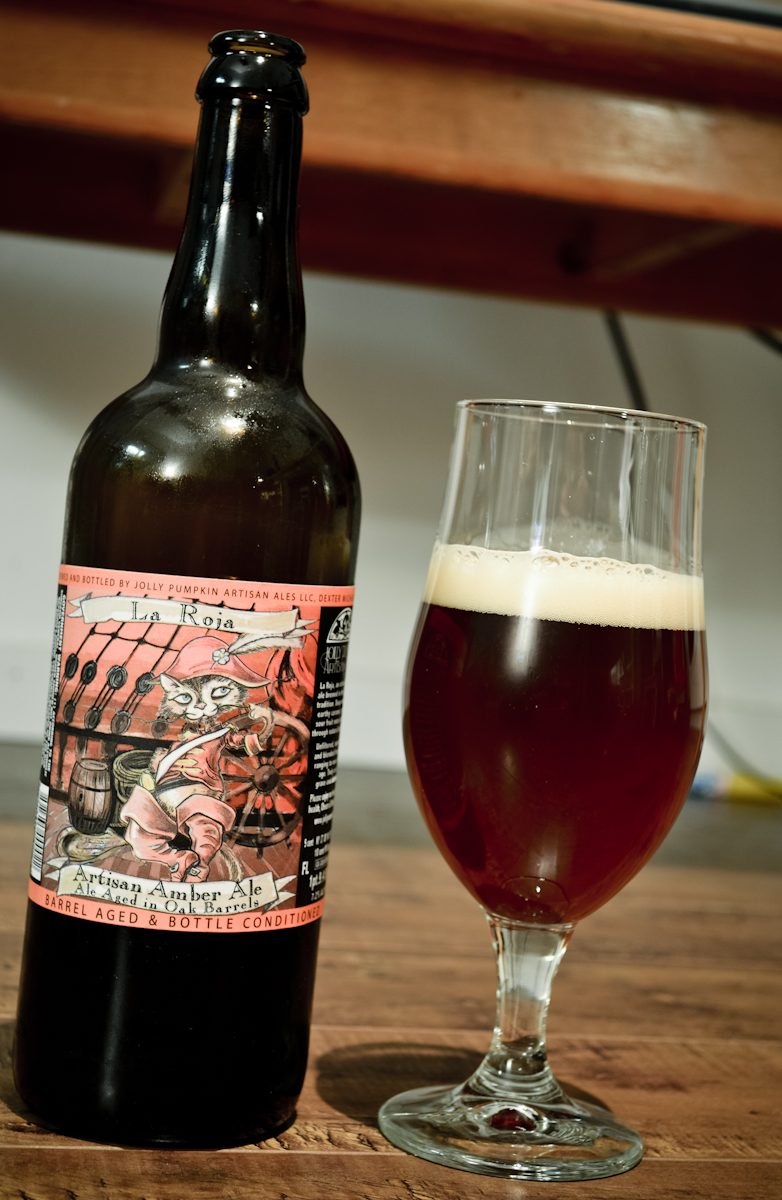
Second is a beer I was very excited to try: La Roja from Jolly Pumpkin. JP are my favourite 'wild' beer specialists if only because of Oro de Calabaza (the "Bam" series are also fantastic). La Roja is an amber ale given the spontaneous fermentation treatment, and it is a success. The beer is a radiant reddish hue, perhaps unexpectedly so given that it is an amber. It tastes characteristically tart and vinegary, but a lot cleaner and less horsey than the Oro. A glimmer of hops manage to shine through the champagne dryness, making this a beautifully refreshing, not-so-challenging sour. Great stuff.

Third is a triptych of newer Driftwood beers. All fantastic, which rids me of the dirty feeling I've had ever since I panned their double IPA. You might argue that Fat Tug is two years old now, but not to my mind. Fat Tug was pretty stellar when it first came out, but there was always something slightly brutish and heavy-in-the-mouth about it that makes the prospect of a bomber seem quite an ordeal.  I often hovered my hand over the 'Tug in the liquor store before choosing something more straightforward — like if someone offers you crazy whips'n'chains sex when all you really feel like is a quickie.

But the last 5–6 bottles of Fat Tug have been different. More refined, richer in aromatic hops, less syrup and orange peel, a dash of melon. It could all come down to perception or fluctuation of ingredient qualities, but I find myself unbuckling at the site of it these days, which can only be good.

Sartori has always been the best fresh-hop IPA we can get. First year was incredible; consensus is that last years' was pretty good; this year's is once again awesome. For the first time, this year's Sartori is brewed solely from local maltster Mike Doehnel's (read this) malt, which is a nice way to round off the local vibe imparted by Christian Sartori's Chilliwack(ish)-born hops. Forthright, smooth and exploding with hop aroma. Wonderful.

Finally, the much-anticipated Bird of Prey series (it's a f***king SERIES!) Flanders Red Ale. I knew this was in the works a year ago. Every time I asked Jason about it he'd make mystical sounds about it being sort of ready but not quite ready. Patience has clearly paid off because this is a lovely, lovely sour ale. Not as sweet as I have come to expect from a Flanders Red (blame Duchesse), the Bird of Prey is actually not a million miles away from La Roja. It is an assertive sour, but not a mouth-gusher. The strength (7.5% apparently) is completely disguised by a beguiling palate of sour cherry, lychee and dry cider. Others have attributed "complex" and "oaky" to it, but I identify with neither description (I am curious as to what it would have tasted like were it not aged in barrels for a year). The biggest charm of this beer is its straightforward refreshment and addictiveness. No palate fatigue whatsoever, which is incredible for the style. My advice: find a falconer and invest in a decent sized aviary. Fast.


Tuesday, November 15, 2011

Moving over to the Dark Side

One of the reasons I haven't written much here recently is my new hobby of homebrewing. No, I am not so absorbed in improving brewhouse efficiency and mastering recipe-crafting that I have no time to write (although these are very absorbing subjects).

The main problem is that brewing makes you look at beer differently, disturbing your once-sturdy perspective as a purely "demand-side" blogger. It takes a while to acclimatize and rediscover that comfortable, blinkered self-righteousness that allowed you to inflict your views on others in the first place. I'm nearly there…

Here are a few observations gleaned from my young homebrewing career that have changed my perspective on beer.

1. It is not easy to make good beer
Most of the homebrewing books I read return to the mantra over and over that brewing might seem challenging, but it is essentially simple. In the grand scale of creative industries, brewing may well be "simple" in that it involves a few basic processes and chemical reactions, but it is still bloody tough to get right. I now feel like a douchebag for reviewing beers as "pedestrian" or "unremarkable" when I'd now consider either term to be an accolade if applied to my own offerings.

2. Someone makes beer
Well, duh. Lots of beer bloggers (me included) know personally some of the brewers behind commercial beers. But when we buy their stuff in a pub or a liquor store, it has the nice label and it's all standardized and we feel the authoritative reassurance of the brewery when we confidently pop the cap and suck. When a fellow homebrewer hands me a beer, I furtively look him over. Is he basically trustworthy? Does he look hygienic? Is she someone whose judgment and ability to do stuff properly in her general life impresses me? My first sips of that person's beer are full of trepidation and concern. I sense myself preparing to reject the beer as unacceptable at the merest hint of an off flavour — far more so, bizarrely, than if they had just made me a sandwich.

3. Drinking sessions have become episodes of CSI
Two months ago I had but the vaguest idea of what DMS, acetaldehyde, or oxidation were. I now know that those charming, mysterious notes that wafted in and out of my palate as I supped a complex beer are faults that must be remedied and resisted. Likewise, even the most desirable of intended flavours must be explained by my inquisitive mind as some product of ingredient, process or equipment. This is so much better than being able to sit and merely enjoy a beer…

I am enjoying brewing very much. I'm into my third batch now and things have come a long way since I ineptly fumbled my way through brewing a stout (which was just bottled at a ridiculously undershot 2% ABV!). Brewing is something I will be doing for a long time, I am sure of that. But I will say this: I had no idea of what I was letting myself in for.

Our homebrew setup

Tuesday, September 20, 2011

When beer gets in the way of writing about beer

Too often a blogger slips in from an absence with a credible excuse about being busy with real life. I have not written in close to two weeks for much better reasons, and all of them to do with beer.

1. Great Canadian Beer Festival
The GCBF took place the weekend before last. My saintlike wife encouraged me to attend both days. I obliged. It was blisteringly hot, but the quality of the beer was excellent. Unlike previous years, I was "working" for much of the festival this time round.

2. BrewVIC
I am one of the "founding members" of Victoria's new home brewers' association/guild "BrewVIC". The website is in advanced beta at the moment under the guidance of Dave S. I compiled a links page of my favourite homebrew resources, I'd welcome any additional suggestions from kind readers… You didn't know that I brewed? Well, I don't…

3. Building a homebrew setup
…Yet. For the last month I have been attacking four empty kegs with angle grinders, drills, spigots, hoses and dirty great propane burners. Dave (from beerontherock) and I have finally completed our brewing system and will give it a maiden brewage with a stout in the very near future. A future blog post is earmarked for a photo rundown of what we have done so far.

4. Campaign
Readers may remember that I recently began to look into the nature of CAMRA in Canada. This project — which began as journalistic curiosity — has morphed into something more. Part of my research involved asking local brewers and retailers "What is the biggest impediment to good beer in BC?" They gave a very consistent set of replies relating to certain regulations and practices of our dear, government Liquor Distribution Branch. This inspired me to learn more, get in touch with lots of other potential-activists, and begin a campaign to promote some changes. I collected lots of signatures for a petition at the GCBF, and there is a small Facebook group setup. If you're a BC good beer drinker, give it a look. I think we stand a chance of going somewhere with it.

Time for a beer in the last of the sun, then I'll think about writing a proper blog post.

Thursday, September 1, 2011

My Favourite Beer Glass

Ian is aroused by a variety of glassware; I am more monogamous. If I had to drink every beer from only one glass I would choose the O-Riedel Cabernet/Merlot "wine" glass. My usual drinking glass is a Unibroue standard, which falls somewhere between a tulip and a flute, and is elegant and suitable for many styles.  If I am drinking while going about some task, like assembling furniture or fussing over the barbecue, I like to use a no-nonsense contoured pint glass. I was recently gifted a nice fat Duvel tulip, which is grandiose but a little much for most occasions. Even ordinary wine glasses are perfect sometimes.

But the Riedel is easy to hold and the circumference of the rim feels natural to drink from. It is capable of holding a whole pint, but looks best half or two-thirds full, which is just right for home drinking. The thin and invisibly clear glass makes for vivid, honest photographs. Washing the fragile vessels can be nerve-jangling, but aren't most of our favourite things vulnerable and fleeting?


Tuesday, August 30, 2011

Ales and Graces

In my last post I (wrongly) suggested that a fellow blogger thought 750ml beers would have appeal because the wine-style bottle lends an air of class. Where would I get such an idea? It is surely not the case that upstart beer looks to its old money counterparts of wine, scotch and so on, for stylistic guidance as it hammers on the highfalutin door of haute cuisine acceptance. Or is it?

It is a point to ponder as I sip my "Chatoe Rogue Single Malt Ale" and eye the bottle of "Phillips Centennial single hop IPA" on the shelf. It's not that brewers have suddenly started constructing beers around the charms of individual ingredients, but they are certainly much keener on letting you know about it. A good dose of beermakers' innovative energy seems to go into emulating the mores and methods of vintners and distillers.

I have even heard talk of terroir creeping into more interviews with brewers. And what are fresh hop IPAs becoming if not the Beaujolais Nouveau for the taproom terroir-istas?

Beer drinkers and writers are just as keen to associate themselves with the snobbier aspects of wine and spirits. Take the growing interest in cellaring, aging and pairing beer. For centuries the battle was to get ale drunk as quick as possible. Aging was an unfortunate necessity that was offset by the addition of preservative ingredients. And pairing? In my own lifetime, before pubs turned into casino-eateries, the closest you'd get to a pairing option in your everyday beer-drinking life would be a packet of KP roasted nuts or some flayed pig skin. 

Of course, the critical question is this: Is it that an appreciation for the contribution of single ingredients, the one-off styles permitted by seasonal quirks, the varied development of flavour through aging, the culinary counterpoints of grog-meets-grub, and all the other things we associate with wine and scotch culture, are in fact part of the natural enjoyment of any refined sustenance-stuff — beer being long overdue similar status?

Or is beer becoming the nouveau-riche, seeking gentrification through emulation, buying a new BMW instead of waxing the Beetle, slinging Christian Dior handbags round its neck, attempting to disguise its proletarian accent while shielding its bad teeth as it signs up for membership at the golf club?


Thursday, August 25, 2011

Size matters: Why 750ml beer bottles don't convince restaurant-goers

I said "order the Yellow Tail," Ulysses. But no, you had to go and show off…
The Beer Nut thinks that the 750ml bottle might be the answer to encourage mainstream restaurant-goers to embrace beer. The 750ml bottle (or "standard" as it's known in wine) is familiar, has an air of class, and lends itself perfectly to sharing with food, argues the 'Nut. Sounds reasonable.

However, I think that the 750ml bottle is both a solution and an obstacle in the quest to increase the status of beer as a "serious" food accompaniment.

Wine works in 750ml bottle for at least two reasons:

1. It is presumed to be a consistent strength (generally 12–14%)
2. It is usually not carbonated

Beer faces problems in the restaurant setting on both these fronts.

1. Beer ranges from 3-14%. It's a whole different undertaking to share 750ml of barley wine as opposed to a bottle of Lindeman's lambik. Restaurant-goers unfamiliar with beer would be doing blood-alcohol maths, wondering if they could finish a whole one, or — worse — ending up drunker than they expected. This all introduces anxiety where a simple bottle of wine would not.

Plus, if you're interested in trying a new wine, most restaurants serve by the glass. Not an option for beer: you can hardly crack a magnum of Karmeliet and expect it to pour ok an hour later.

2. If you've ever worked in a restaurant, you'll know that most customers live in fear of doing the wrong thing or being faced with a culinary challenge they are not up to. You might love crab at home, but you don't want to have to rip one out of its shell with a set of nutcrackers in a room full of strangers. Even the "how do you like your steak" question fills some people with existential angst. 750ml means customers will be pouring each others beers. Many will think there is a "correct" amount of head, not know how much to pour, get nervous about that murky bottom inch of sludge — in short, another level of anxiety.

Bottom line: beer is more complex than wine, it doesn't conform to expectations, it behaves in weird ways. Beer geeks and adventurous patrons might appreciate the larger format, but ordinary restaurant goers are likely to be too intimidated to become accustomed.

The best way to promote beer in restaurants, for me, is to accentuate its variety, suggest pairings on the menu, and serve it in single serving sizes — preferably in specialized glassware. Servers should offer to pour your glass and leave you the empty bottle to examine at your leisure. Removes all anxiety and ensures a better experience all round.

Sunday, August 21, 2011

Some Unexpected Beery Gifts

Beer drinkers are by far the easiest people to buy for. As with all hobbyists, the gift-buyer has a helpful theme to guide their purchases. But with crime fiction geeks, stamp collecters, and the like, you're always gripped with the same anxiety "Wonder if he already has this…"

This is not a problem with beer drinkers.

"Happy birthday. The guy at the store said it was a good one. You haven't drank it before, have you?"
"Several times. Got three in the cellar. Split one with Jeff this morning as a matter of fact. Ooh it's cold. It's perfect I LOVE IT!"

Recently two lovely people surprised me with beer gifts of remarkable quality. I want to say thank you.

At a recent kid's party I took my daughter to, I got chatting to the grandmother of the birthday boy — a gifted potter who had made some great clay beer mugs so that the dads could drink beer at a child's party with impunity. I mentioned my own preference for a handled mug like a Stein or a Tankard. Two weeks later a shoebox turns up at my daughter's daycare, addressed to me:

Each mug holds 600ml, was fired to 2200 ÂşF (making it "mid-range", a very durable pot), and both are coloured with varying combinations of the colours "Brown Sugar" and "Roses are Red" (inspiration came from here). These details will mean more to potters. Most important for me is that, aside from looking quite beautiful, these mugs are great drinkers. The tankard especially has a pleasing plumpness, and I enjoy feeling the fine grain of the clay warming as I slowly swill a mild ale. Thanks so much, Sharon!

Next up is this lovely tray, bought for me by Ian the "beer prick". It features five offerings from the Northern Club's Federation Brewery Ltd (Newcastle on Tyne).

Now, there is a bittersweet end to this tale of generosity. While researching the Federation Brewery in order to write this post, a thought occurred to me: Could this be the same Federation Brewery responsible for Federation Ace Lager? A.K.A 8Ace — also the name of my beloved Viz cartoon character of the same name, who has a truly special fondness for "th' ace"?

It is. This tray was made by the same people who made 8 Ace. A more perfect gift (except 8 cans of Ace) I could not imagine.

Unfortunately, I also learned that the Northern Federation Brewery went out of business this year after 82 years of brewing (most of it superior to Ace, I happily report). But now they have been unceremoniously ousted by owners Heineken UK.

Gone.

Sniff.


Tuesday, August 16, 2011

Review: Driftwood Twenty Pounder Double IPA

I had only recently finished typing a comment on someone else's blog about how to deal with bad beer experiences as a beer blogger when I found myself — like a character in a Charlie Kaufman movie — intimately enmeshed in the very world I was describing.

I am drinking Twenty Pounder IPA, which is a much-awaited beer from my absolute favourite local brewery. It was released today. It is one of my favourite styles. And I'm not enjoying it at all really.

The blog post I alluded to earlier was one of a series, really. A few British beer bloggers have been tossing back and forth about how to deal with bad beers. Should you be honest? Should you even review them? Is it fair to say bad things about good people who have crafted a beer that you just happen to hate? That sort of thing.

I have no answers to those fundamental questions. I focused on what I consider to be the blogger's duty to his reader(s?). This is my bit:

One overlooked variable in the quandary of how to approach negative criticism is the nature of your blog itself. No one is a mere "blogger" — our blogs are driven by different aims and angles. A blogger identifying as a straight reviewer or appraiser absolutely has the responsibility to be frank about poor experience, whereas the philosopher or geek of beer minutae can dodge even having to think about how to handle it.

Bloggers who consider themselves more generic or personal in their approach are obliged in other ways. You build up a relationship with your reader who — in turn — trusts you and expects things of you. If you have spoken candidly on poor experiences in the past, or made gestures at cutting through the crap, then you would serve your reader best by spilling the beans. But if your tone is overtly sympathetic and your readers view you as a convivial proponent of the whole good beer scene — then you would not be misleading anyone if you were to damn with feint praise now and then…

SO where does that leave me with the Driftwood beer? Well, I've always screamed at the top of my lungs about how much I love them, and I've always been honest. I feel I have no choice.

The beer pours a mid orange, with a chunky head that leaves some persistent, patchy lacing. It is a crystal clear DIPA, which may or may not have something to do with the fact that Driftwood have begun to filter a little.* The aroma is very reminiscent of the Fat Tug IPA, which isn't my favourite Driftwood beer, nor is it my favourite local IPA, but it is a worthy brew that I often order and enjoy.

The nose is powerful, orangey, thick, tropical, somewhat cloying, but pleasant. Initially it tastes like a barley wine: syrupy and luscious, but with fairly sharp hop notes. The hops never really get going for me; they are excessive in no particular direction, lending to a rather characterless effect. Stewed apricots come through, but that's about it. I think that malt-lovers would be disappointed, hop-heads alienated.

Then the worst bit: a brutally astringent, chemically finish with all the grace and élan of a nail varnish jell-o-shot. Bad enough to be called flawed; so much so that I'd chalk this off as a bad bottle had it not only just come off the line. If this is 20lb-er as intended, it definitely falls somewhere between "not-for-me" and plain old "gross".

………

*I don't know why I wrote that Driftwood have begun to filter their beer. I think I got my wires crossed somehow based on the fact they have recently introduced an "unfiltered" sticker to some of their beers. Pure confabulation. AFAIK they do not and never have filtered. 

Thursday, August 11, 2011

Canadian CAMRA Studies #1: Fraser Valley CAMRA

Recent debates about the relevance of CAMRA UK gave me pause to muse on Canada's growing number of CAMRA chapters. On the face of it, the original aims of CAMRA do not seem to apply to Canada where there has never been a tradition of cask beer nor any particular threats to it. If Canadian CAMRAs are just Canadian Beer Appreciation Clubs, why not call them that and be done with it? Musings turn into obsessions pretty quick in chez smallbeer…

This is the first in a series of blogs in which I excavate the murky tar-sands of CanCAMRA and emerge, triumphant, with oily fists full of truth.

………

The best place to start seems to be with the most recent chapter in Canada: Fraser Valley CAMRA located east of Vancouver in British Columbia. As far as I can tell, the only chapters in Canada are in British Columbia: Ottawa had one that died, rumours of one in Toronto failed the Google test, and apparently someone absconded with Calgary CAMRAs funds, ending that venture.


I spoke with Vice President Jonny Tyson and communications guru Jason (whose position I regretfully failed to confirm) today to find out what their chapter is all about.  I will be publishing information about what seems to be a thriving beer scene in Fraser Valley on our BeerOnTheRock blog. Right now I'm only interested in the "why CAMRA"? question.

Upon calling Jonny I get the sense my question is already answered, as a familiar London accent meets my ear. It turns out that Jonny's love for cask beer and subsequent interest in CAMRA do indeed stem from a youth spent supping bitter in London pubs — an experience whose virtues were only truly appreciated upon Jonny's arrival in Canada.

"That taste and experience of real ale is something most Canadians don't even know exists. I think it's important to keep that going and to introduce it to people," says Jonny.

Fraser Valley's chapter was started by Mike Victory, Jonny, and a handful of other real ale converts whose passion for good beer was strained by the commute to Vancouver CAMRA meetings and the riches of the urban beer scene. They quickly realized that if they pooled their local member base they could stimulate the local scene and avoid the interminable #YVR traffic jams. Fraser Valley CAMRA was born in January 2011 and has grown from a core of 40 members to around 75 — aiming at 100 by Christmas.

Nice, but what have they achieved?

"Fraser Valley now has regular cask events. We've held two at Kingfishers and there will be one at Billy Miner — their first cask event ever. Kingfishers have given us massive support, they're a real hub for us. Our core members are very active and the scene is responding. The Billy Miner pub used to have one craft beer tap, they're installing something like fifteen now. Mission Springs brewery is supplying casks, Central City sponsor us, and local beer stores are filling up with craft beer."

OK so they love cask ale, but surely an organized Fraser Valley beer collective could have put the same pressure on local pubs and stores. Why borrow the CAMRA epithet?

"Cache. Maybe we could have nudged the scene, but the CAMRA name brings weight. It attracts more members. It's recognizable."

In other words it's a "brand" — a word I'm instinctively hostile toward, but I can see that I need to reconsider my prejudices based on the indisputable good the CAMRA name has done for Fraser Valley. Some of the grumpier Canadian drinkers you find moaning on BeerAdvocate forums about their miserable local scenes would do well to take a leaf out of Fraser Valley's book and get organized — it really can make a dramatic difference.

But when all's said and done, CAMRA UK was born out of historically adverse circumstances. They've even made a film out of it (incidentally the trailer of which features my own local, the Malt Shovel Tavern in Northampton). Isn't it sacrilegious to take a name forged in the fires of social conflict and append it to some beer geeks' unwillingness to select a designated driver to take them to a decent Vancouver boozer? What possible problems face the ostensibly thriving craft beer scene in BC???

"It's true, we don't have the same problems here. BC craft beer sales went up by something like 30% last year. But there are problems… Big brewers are looking to buy out craft breweries, not to mention the tied houses regulations in BC might be abolished. That could get nasty"

Jonny is right. Until now BC has enjoyed some sensible regulations that prevent large breweries from essentially bribing outlets to favour or exclusively stock their products. For anyone who has had the "pleasure" of trying to find a beer at a local hockey game only to find a choice of one or two (shit) beers at extortionate prices — this could be the future of BC watering holes if certain interests get their way. In such a scenario, one could imagine a real need for a dedicated consumer rights movement. I can say with confidence that CAMRA chapters such as Fraser Valley's would be ready-made for exactly those purposes.

Jonny and I end our conversation and I find myself reappraising CanCAMRA. What was hitherto for me an object of affection and mild derision has taken on the unexpected aura of a sleeper cell of underground resistance to potentially hostile forces intent on forcing me to drink Keiths pseudo-IPA. As the recent Vancouver riots have proved: we might as yet have absolutely no reason whatsoever to get miffed about anything at all — but British Columbians look to be more than ready for the ruckus should it eventually turn up. And that's at least in part thanks to CAMRA.


Tuesday, August 2, 2011

CAMRA Obscura

A Victoria CAMRA Member

CAMRA is a hot topic for bloggers right now. People are debating the absence of brewers and types of beer at the Great British Beer Festival, whether CAMRA is at some sort of existential crossroads, and how best to represent good beer now that the "craft movement" has departed from what have traditionally been considered the best brewing practices.

To my knowledge, only two Canada-based beer writers have waded in with any force on what are chiefly British concerns (my excuse is being British; Alan will gatecrash any party whose guests include beer and passion). It is to their credit that no UK folk have told us to fuck off on the basis that it has little to do with us (perhaps they will now I've admitted I'm an imposter). But I have wondered whether it is my business and, frankly, why I care so much.

My wondering has led me to this answer:

Like many, I look for meaning in beer. I'm a sociologist, but also a hormonal marxist who cannot help but seek solidarity with others in my passions and pursuits. Something about the way the North American "craft beer community" (or worse, "movement") is packaged in various social media outlets feels phony and tacky to me. More power to them and no disrespect to the individuals involved, but gestures like the I Am a Craft Beer Drinker video make me cringe inside. I can't identify with it.

I get great satisfaction through companionship and spanning time with local drinkers, brewers and writers here in Victoria. But I also hunger to connect beyond that, which is why at least half of the beer writing I read regularly is about the complicated world of UK beer. Beer culture in North America – like a Hollywood movie – has a neat and knowable history, clear-cut baddies and goodies, and a current feel-good triumphalism. In many ways thrilling yet unengaging. British beer has an enigmatic history, diverse sagas and side-narratives, and complexly-developed protagonists — of whom CAMRA is certainly one. More Mike Leigh than James Cameron.

CAMRA in particular fascinates me. Alan flippantly observed a parallel with the Tea Party — a comment that I found more insightful than perhaps he intended. Like the original Tea Party, CAMRA shares a common tragedy with all insurgent movements: successful revolutionaries often find themselves in the dubious position of becoming establishment conservatives. CAMRA's original struggle — to save cask ale culture from mass-production (which happened to favour kegging beer) — plays a similar role to the American Constitution for modern Tea-Partiers: it offers a stubborn lens on a political landscape whose struggles have shifted considerably, pitching those with many common interests against one another for the sake of antiquated loyalism.

With this in mind, I sit here with my CAMRA Victoria membership card in my hand and experience a bit of a revelation. What has CAMRA in Canada got to do with UK CAMRA? Besides the love of good beer, I can't work out what the affinity could possibly be. There has never been a cask-ale tradition here let alone a threat to it. CAMRA Victoria started well after the early-1980s good beer trend started.  A few internet searches later and I realize that I cannot find any up-to-date references of any CAMRA chapter outside BC (besides some old mentions of CAMRA Ottawa — which seems to be defunct).

Suddenly feeling a chill, I wonder if CAMRA UK even knows about us. Another internet search reveals no links at all! I recall a recent article about an enterprising businessman in China who set up an exact replica of an Apple Store — down to the shelf-fittings and polo-shirt wearing uber-geeks — and sold Apple merchandise for months before being rumbled. Are we imposters? Am I in a cult? Am I part of an underground splinter group with secretive aims to subvert NA craft beer optimism with archaic, esoteric in-fighting? AM I A REPLICANT?

North American beer culture just got interesting for this CAMRA member…

Wednesday, July 27, 2011

Trending Upwards

If you can read and you like beer you will have noticed that three things are trending in beer right now:

1. Collaborations
I read today that local outfit Phillips are brewing a Belgian IPA with Halifax's Garrison. There are special circumstances behind this particular collaboration, but it proves even our Island outfits have joined the throngs of brewers eager to mash each others' tuns. Brooklyn and Schneider did it, twice. Dogfish head will do it with literally anyone. Even hirstute beer bloggers are getting in on the act. (humble old us did it too recently, but we don't like to shout about it)

2. Beer cocktails
When the Beer Wench is mixin' IPA-a-rita in the same week that Alan McLeod is eying up saucy suds, you know it's beer cocktail silly season for the twitterati.

3. Belgian IPA
It's hoppy, it's yeasty, it possesses the unqualifiable characteristics of Belgian beer whilst simultaneously usually not being brewed in Belgium nor being in any way shape or form an IPA. It is, inexplicably, the Belgian IPA. It makes no sense, but it sounds delicious and people are in love with the concept of it anyway. More power to them.

The small beer blog likes to trend hard; it has been known to go on a three-day-trender. So naturally I felt compelled to make all three trends meet (within a tight budget) with my passive-collaborative-beer-cocktail-Belgian IPA: I dumped a can of Red Racer IPA and a bottle of Unibroue Fin du Monde into a right big glass and glugged it.

Blending beers has always been a core component of the production of many beer styles (ok ok I know it's not exactly a 'cocktail'). Depending on which sources you believe, porters were often produced with up to three separate brews. The Duchesse du Bourgogne Flanders Red I drank last week is a combination of an aged batch with a newer one — something that Guinness used to do (possibly still does?) with the addition of some sourish beer to produce a desirable twang.

Blending is not the same as brewing a beer with the combined ingredients of the blend, of course, as different yeasts and fermentation processes obviously nurture different flavours from each batch. I tend to mix two ales together from time to time on a whim — just to see if it'll work. But this was my first intentional blend and it worked out beautifully.

Fin Du Monde is a dry and pungent tripel — oozing peppery yeast in the classic Belgian mode, and Red Racer IPA is probably the most aggressively hopped, well-made IPA brewed within Canada. In combination they did not disappoint. I was very surprised that even in a 50/50 mix the Fin Du Monde engulfed what I presumed would be the more dominant hop-ridden bedfellow. The result was a very mellow, thick and resplendent drink. The bite of the yeast played well with the subdued, complex hops. The flavour was perhaps muddled after a too-cold first pour. But when it warmed up a bit it was really very lovely.

Give it a go with your favourite local Tripels and IPAs, or perhaps saisons too if you have them. But never, ever, EVER a Dubbel. It would only encourage someone to coin "Belgian Dark IPA": not worth the risk.

Sunday, July 24, 2011

Tasting Notes

After one sip of my first ever Duchesse Borgogne last night my face spasmed — fluctuating between an involuntary sour grimace and a beam of sheer delight. I try to resist the temptation to read descriptions (and worse: reviews) of new beers before I try them. As any movie-goer will attest, expectations and predispositions can be the arch-enemies of enjoyment. I hadn't even realized the Duchesse was a sour Flemish Red until it curdled my consciousness and tattooed a smile across my cheeks that lasted all evening. The shock of the sour with the luscious mead-like body really pleased me.

Our physical reactions to tasting beer are an oddly personal thing. Mood, fatigue and above all company can be more significant than mere flavour in determining whether we roll our eyes, adopt a stony snarl, or launch into a full-on "o" face. As animals our reactions to flavour are essentially carnal, yet as social creatures we have learned to become aware of and control how those reactions bubble up to the surface.

Personally, my tasting reactions mirror my reactions to good comedy. If I am watching The Daily Show or listening to The Bugle alone, even the most uproarious gags might solicit an appreciative nod — a monosyllabic chuckle at most. But put me in a crowded cinema and I will bellow through a full ninety minutes of a mediocre Will Ferrell flick. Similarly, a great beer enjoyed in solitude might fire up my synapses, but put me in a beer-tasting and the same beer could reduce me to giggling jelly.

On some occasions company has the opposite effect. We've all been in situations where someone has split a rare or celebrity beer and the gathered tasters proceed to play flavour-poker, stifling their visceral reactions – whether delight, disgust or indifference — for fear of betraying unsophisticated tastes or a misunderstanding of the intended style. It takes a bold or blasĂ© comrade to break the seal: "It's OK, but I have no idea why BeerAdvocate drinkers have it as the best of its style" before others will wear their frowns of disappointment with confidence.

My favourite tasters of all (my taste in tasters, if you like) are those awesome individuals with a winning combination of hyperactive tastebuds and a total lack of inhibitions. There is one such guy called John who comes to our semi-regular Epic Beer Dinner pairing events. I always search the RSVP list to see if John is attending, and if he is, I know we will be offered a veritable showcase of joie-de-vivre.

John reacts to a beer the way ordinary people might react to being publicly slapped, tickled by a platoon of Oompa-Loompas, or being told they have less than three minutes to live. Reactions explode out of him. I once saw him react to an imperial Hefeweizen as though it had just suggested that John and his wife join it in a three-way.

I've never seen someone perceive such audacity, outrageousness and utter seduction in the beers that John drinks. I salute him. Most of us cannot be like John, but all beer lovers have their own version of this reaction. We might simply sit, aware, in the serene moment, feel an immediate compulsion to write about what we just drank, or snap a pencil lead scribbling tasting notes.

And now, because my words do not have the power to replicate intense visceral reactions, for John and the Duchesse, a video of some small children eating lemons.

Friday, July 22, 2011

The 'Rock is Rolling

The BeerOnTheRock executive meeting took place last night. Dave, Ian and I managed to plan some changes to our Vancouver Island beer news resource before our sobriety clock ran down and we were reduced to watching a man inhaling his own boot on YouTube.

BOTR currently just does Island news and announcements, but we will start doing two other things:

1. Articles
BOTR is intended to be opinion-free (saving rants for our blogs), but our main aim is to promote our beer scene. We have decided therefore to start writing feature articles, e.g.:
  • profiles of local breweries/brewers
  • interviews with beer-related folk
  • historical bits about the beer industry here
2. Homebrewer's guild/community
Victoria does not currently have a homebrewers' organization. We have been in touch with some guys who have been planning to start one and it is likely that we will either host it or publicize it and certainly cover it. Dave and I are building our own brew operation; Ian already brews.

If any Island drinkers want to suggest another angle we could pursue on BOTR, feel free, we're here to serve. 

OK now to the important business of what we drank last night:

Howe Sound's latest beer "Brilliant Lager" (and first in a can) is a Dortmunder-style lager. DAB — an exemplar of the style — seemed a natural comparison point. Both beers are solid, relatively malt-forward with minerally-hops. But I preferred the DAB which was crispier and more tart.

Second up was my beer-revelation of 2011 Weltenburger Kloster's Asam Bock. It is a dark doppelbock named, as far as I can tell, after the Brothers Asam — a pair of 18th Century German artisans (architect and painter, respectively). Such a lovely beer — warm and soothing, not too sweet, hint of chickory, and a clean finish. I used to pass this one by because of the antiquated label and its low price — I assumed it was a throwaway import. Since then I have had four other varieties of Weltenburger and I cannot recommend them enough.

Next was a half bottle of Dogfish Head's World Wide uber-imperial stout. Ours was a muddy brown, not black, and frankly not lovely. It had a great oily texture and all the concentrated liquorice and treacle flavours you'd want to see —but it was also a bit astringent and bitter.

The Serendipity pair were interesting. I had the bright idea of doing them in reverse order to save the oldest for last. The No.2 was much as I remembered it — a fairly nice bourbon-infused hybrid ale that could have used a more robust backbone. The No.1 was utterly infected and tasted like mouldy lime peel.

These out of the way we turned to Ian's gentle homebrew: a light, light bitter that eased the meeting to a close.

Tuesday, July 19, 2011

Keeping it Real: UK CAMRA vs. BrewDog

A dispute between Scottish brewing provocateurs BrewDog and CAMRA UK — who run the Great British Beer Festival (GBBF) — has ended with BrewDog being denied a spot at this year's GBBF. Working from BrewDog's complaint (I am assuming they accurately portray the issue as I am not aware of a response from CAMRA) the issue boils down to this:

  • CAMRA rules state that all British attendees must supply cask beer; only non-Brits may bring kegs due to difficulties in transporting casks and the fact that many beer styles are not appropriately presented in casks.
  • BrewDog contend that they had achieved an agreement to bring kegs of beer (their preferred method) which was reneged on by CAMRA; BrewDog are now not allowed to attend with kegged beer as their arrangements did not fulfill the terms CAMRA would accept in their agreement. [EDIT: Steve Lamond points out that it was not a renege, BD just didn't meet certain requirements]

Putting aside the issue that CAMRA may or may not have had an agreement with BrewDog to allow an exception in their case [EDIT: and also the fact that the technical reasons BD were refused was their failure to meet contract in terms of payment date and vessel size], I think that this issue represents a fundamental flaw in CAMRA that will certainly undermine its long-term aim to advocate cask beer. Here's why:


My first response was echoed by Pete Brown's tweet: "if the defence is 'We're all about real ale, that's the name," kindly rename the Great British BEER festival". This is obviously correct. Defining "great British Beer" as that solely served in cask is as luddite and arrogant as it is inaccurate. Modern beer producers have refined so many approaches, elevated so many styles to greatness, that I wouldn't be surprised if we see even "craft" rice and corn beers before too long (all right, don't mark my words on that one).

CAMRA's stance on cask beer is clearly linked to their raison d'etre: namely their admirable defence of cask ale from the threat of extinction at the hands of large corporate interests whose production methods and aggressive marketing were rapidly making kegged beer the only viable commercial option.

If you define CAMRA as a defence of cask beer against kegs, then it is wholly understandable why they'd take this precious stance. This explains why so many CAMRA advocates are (possibly reluctantly) supporting the cask-only policy.

But that is not how CAMRA should be defined. What they did, in essence, was protect a form of production and enjoyment that enjoyed wide appeal from powerful organizations and a commercial movement that was attempting to redefine "good" beer, and to unfairly marginalize other forms of production.

Kind of like what CAMRA are doing now by excluding kegged beer from the GBBF.

CAMRA began as a reactionary organization with noble aims, many of which persist to this day. Unfortunately, CAMRA now resembles a protectionist organization clinging to an outmoded hierarchical dogma that is doing its utmost to live up to the out-of-touch dinosaur clichĂ©s it has been (mostly unfairly) tarnished with since the 70s. Its "not in our backyard" decision to allow Euro breweries to bring kegs, but deny Brits the same privilege — makes CAMRA look like a possessive husband, dragging his long-suffering wife to a strip-club while forcing her to wear dungarees and a raincoat.

Surely all they will achieve is to alienate drinkers who recognize the inherent quality of kegged beers such as BrewDog and who wonder why the resurgent "real ale" has become our sole revered product. This, in turn, risks a backlash against cask ale and CAMRA itself — potentially undoing much of the good will toward 'real ale' that has been achieved over the last three decades.

The obvious solution to this miserable state of affairs is to either rename the festival to the Great British Cask Beer (or 'real ale') Festival, or to allow kegged beers into the GBBF — perhaps on a system that allocates a certain amount of space to casks and a certain amount to kegs. There seems to me no good reason why a quality assessment board cannot allocate space based on the merits of beer regardless of whether it is kegged or casked.

I am glad that the Canadian branch of CAMRA of which I am a member is more of general beer appreciation club that works to promote good beer in all its forms.

EDIT:
commenter one points out key points I missed. I concede that I interpreted BD's complaint rather quickly. However, the overarching point of the post is that favouring cask ale in context of Great British "Beer" Festival is the main problem. It is inaccurate and prejudicial and particularly difficult for newer drinkers to understand.

Friday, July 15, 2011

On Scandals of Red Bricks and Red Tops

British Sunday "newspaper" The News of the World — famed for tawdry celebrity exposĂ©s and populist moral crusades such as the "name and shame" campaign that outed known pedophiles — folded this week amidst a truly repugnant phone hacking scandal. As Rupert Murdoch flies in to England for damage limitation/cynical rebranding of his other rag The Sun as The Sun on Sunday, all I can really think to do is microwave some popcorn, crack a beer, and watch the whole shit show go down in lurid detail.

So, while we're on the topic of hackery and rebranding, did you notice I gave my blog an extreme makeover?

Wait, let me try that again.

While we're on the topic of hackery, rebranding and "naming and shaming" — I have to pay tribute to Wolf Brewing Co. (formerly Fat Cat Brewing) of Nanaimo BC. In a week where the headlines have left a taste so bad in everyone's mouth that a turd sandwich would be considered a palate-cleanser, Wolf Brewing's Red Brick IPA should be applauded for wringing fresh grimaces from my over-worked wince muscles.

Dave told me it was the same recipe as Fat Cat's IPA, something I'd read elsewhere. This raises two questions: Why take over a brewery, change its name, and produce exactly the same beers? and Can Fat Cat's one really have been this bad?

The nicest thing about Red Brick IPA is Wolf's new old-timey stylings. The new bottles resemble those of several blended scotch whisky brands; the artwork is well done and approaches classy. The beer itself is not too reminiscent of the style I know as IPA. Wolf's beer is citrusy enough, but not in an aromatic way. Red Brick has a lemon rind flavour and is generally unsuitably sour and lifeless. The hops are strangled and anemic. As I was debating whether to bother with a second pour, I noticed the description on the label reads "impressive west coast style IPA": that's about as accurate as it is humble.

I don't like giving a local(ish) brewery a kicking, but on this evidence it is deserved. To be fair to them, perhaps Wolf are maintaining these recipes while they get a sense of their own approach. I do not know much about the new owners, they could be just finding their feet — so by all means try their beers for yourselves. But if Wolf's management wanted advice, I'd tell them to launch one or two new lines with straightforward appeal and lots of quality. This aint gonna cut it.

If you'll excuse me, I have some popcorn to get out of the microwave and some schadenfreude to extract from some squirming media moguls. Now that's tasty.

Saturday, July 9, 2011

Street Beer

After a dizzying experience hosting my daughter's (4th) birthday BBQ at a beach (we lost her twice and a crow ate part of her cake), I find myself at home, several hours later, microwaving some left-over street meats and contemplating what to drink.

"It's time," I said to my wife.
"You're going to drink that can of Cariboo I found in the street aren't you?"
"Yes!"

I was interested in Cariboo back when I worked in the Hillside Liquor Store. HLS's fridge is divided into sections according to how cheap or rubbish a beer is. Starting at the posh end of the store you have the bombers and quality imports, then the good BC micros like Tree Brewing, then the crappier ones like Granville Island, then your Kokanees and Buds and Canadians and all that shit.

Finally, at the end, you get the weird ones you don't really know where to place: Bowen Island, Moosehead, Wildcat. These beers are cheap, but their labels are at least more interesting than the bland landscape of silvers, reds and blues in the macro fridge next door.

Cariboo is one such beer. "Brewed with spring water" it announces, above a jaunty picture of a leaping Cariboo and a cute, curly yellow logo (that looks like it says "Cariboos" to me).

Maybe it was the glimmer of yellow on green that caught my wife's eye as we walked home one night last month. I picked up the dented can, musing that a hammered student had probably let it slip from his grip and written it off as burst on his way to urinate on someone's porch. I stashed it in our kid's stroller for a laugh more than anything else and we walked on.


But here I am, feeling as battered as the can, munching a reheated burger and sucking gratefully at the simple yellow goodness of Cariboo. Nice.

--

small beer would like to hear reader's reviews of beers that you found on the floor, if you'll admit to it of course…

Monday, June 27, 2011

Photosymphony

Hello reader.

I feel suitably recovered from becoming a dad for the second time to get back to important activities once again. A slow start perhaps, as I will just be posting a collection of recent beer photographs just now. But this doesn't mean I've been slacking — why, we brewed our own espresso dunkelweisse and wrote an article about it and got a double spread feature for Monday Magazine's beer issue.

Not bad for a dude covered in babypoo. On with the show:

Westy 12 bottle cap shot. Beer courtesy of legendary wife.

Yummy Spring Rite, Driftwood's Local Malt Abbey Ale

The five grains used to brew our Espresso Dunkelweisse.
From front to back:
blurry malt, husky grain, fullcup malt, vague wheat and barely-visible stuff

Dave and I celebrated my son's birth with two lovely barley wines,
a decent stout and a punchy little stogie.

Went crazy with the Lightroom settings. Can't remember what this is.